
Algemeen Testing the limits: how Lotto Dstny optimizes time trial performance on the track this winter
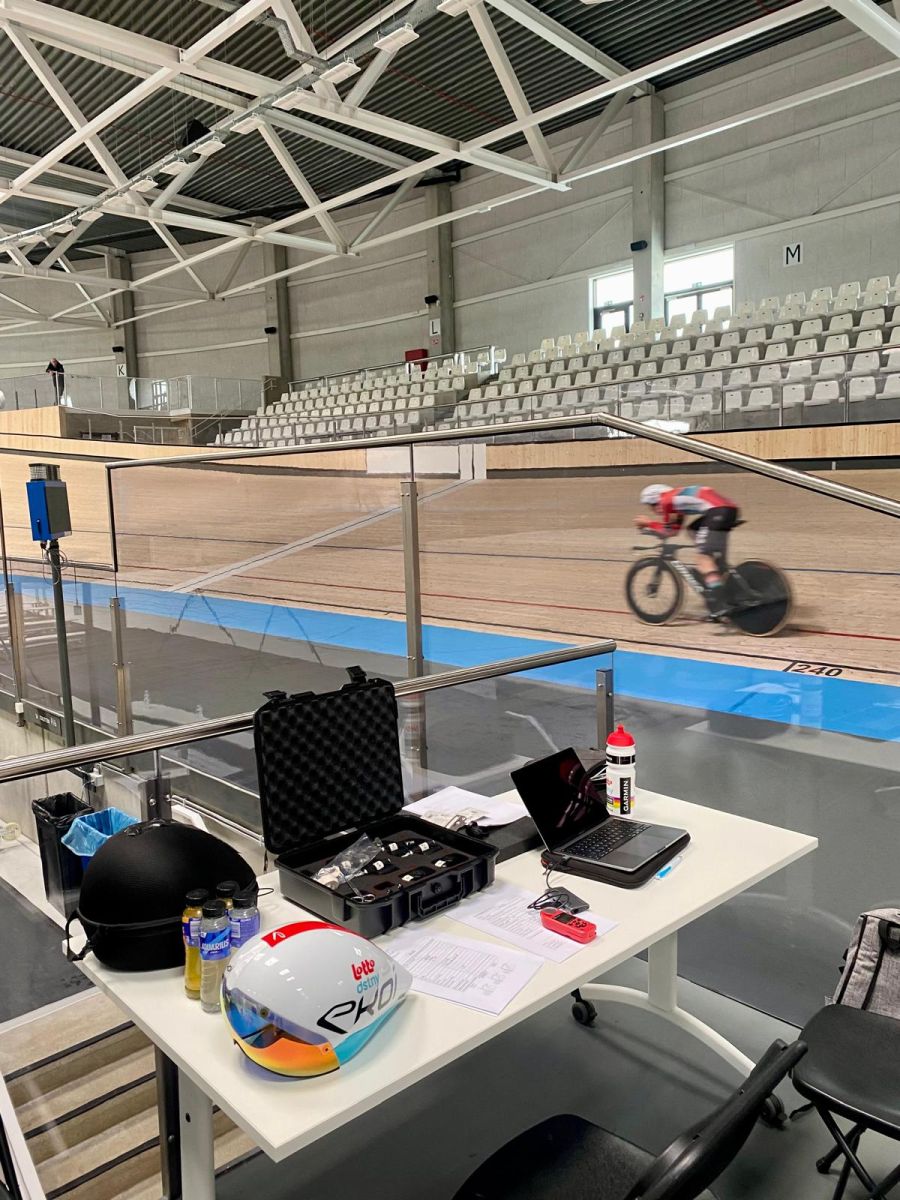
Why do our riders use one helmet in race X and a different one in race Y? Which overshoes are the fastest? How does a time trial helmet sit as aerodynamically as possible on the head? And what’s the perfect position for time trial success for a certain rider? These are the kinds of questions that have been answered as accurately as possible over the past few weeks at Zolder, where a select group of Lotto Dstny riders, under the watchful eye of our performance team, aerodynamics specialists, and engineers, underwent a series of tests.
Oliver Delaey, performance coach at Lotto Dstny, explains how such tests are conducted:
“Essentially, a rider arrives on a test day as if he were preparing for a race. He brings his bike and wears the gear he would use during competition. We try to replicate the race setup as closely as possible. We also record environmental parameters such as temperature, humidity, air density, and air pressure.”
To standardize the tests, the team developed an algorithm that produces a so-called CdA value. CdA expresses the drag area of an object by combining the drag coefficient (Cd) with the frontal area (A), essentially measuring its aerodynamics. “To calculate the CdA value, we record speed and power during a test run and plug them into the formula,” Delaey explains. “The rider gets on the bike after being weighed—along with the bike—this is taking into account along with relevant environmental factors. He then completes his baseline test run of six to eight laps at three different speeds. For instance, he starts with six laps at 40 km/h, followed by a recovery lap before building up to seven laps at 45 km/h, and finally, eight laps at 50 km/h. The test doesn’t need to last longer because fatigue would increase the margin of error. Afterward, we process all data to calculate a CdA value for each speed of the baseline test run. After that, we apply a modification regarding his position (e.g. handlebar width, -height…) or material (e.g. cockpit, bidon, clothing, helmet…) and we start a subsequent test run. We repeat this procedure to approximately six test runs per session, the test doesn't need to last longer because fatigue would increase the margin of error. Comparing the different test runs allows us to compare different positions and/or equipment at three distinct speeds and helps us to find the optimal setup."
The track tests provide a wealth of information, primarily for our time trial specialists who aim to be as aerodynamic as possible on their bikes for their first time trials of the season. But the insights also benefit the rest of the team. “We also conduct general tests, which we process into a database to create guidelines for the entire team. This way, even those who haven’t undergone individual testing can benefit from our work. For example, when it comes to helmets, we might know that helmet X performs best in race Y. Even if that helmet is 200 grams heavier, it might still be more aerodynamic and outweigh the heavier weight in a certain race. This process allows us to build a comprehensive database for all our equipment.”
Picture: Brecht Steenhouwer
